 EZVIZ no longer supports Internet Explorer or earlier versions, and the site may not behave as expected. Please upgrade to a newer browser.

It's late at night, you're about to go to sleep, and a notification pops up on your phone: "Motion detected." You open the app, check the camera feed... and there is no one there. Maybe it was a moth fluttering near the lens or shadows from a passing car. This is a common scenario, and when it happens repeatedly, those alerts start losing their importance.
Smart detection in security cameras is designed to solve this. Powered by artificial intelligence, these cameras interpret real-time events to distinguish between a relevant security threat and everyday background activity, helping you feel more confident when you're away.
This technology makes home monitoring clearer and more effective, fitting naturally into your household's daily routine.
AI-powered detection marks a major evolution from traditional motion detection. While older systems triggered an alert for any shift in pixels, modern technology actively classifies what is moving. Depending on the camera model, the system can recognize different types of activity:
• Humans: Recognizes human shapes to filter out swaying trees.
• Vehicles: Identifies cars or bikes entering your property.
• Pets: Monitors your furry friends without triggering "intruder" alerts.
In EZVIZ cameras, this capability relies on advanced shape recognition and motion pattern analysis. This allows the system to differentiate between routine daily motion and a high-priority event that demands your immediate attention.
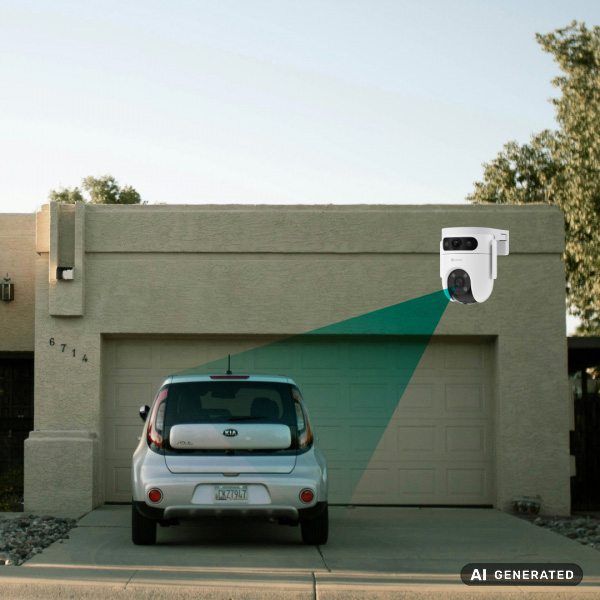
By combining high-performance image sensors with digital data processing, the detection process operates through four key stages:
1. Capture: The image sensor continuously captures video frames, while detection algorithms monitor the scene for changes.
2. Filtering: The on-board AI chip analyzes the frames to filter out irrelevant motion like rain, wind, or light fluctuations.
3. Classification: The processor uses object classification algorithms to identify whether the movement matches a person, vehicle, or pet.
4. Automated Response: The camera instantly sends a mobile alert, starts recording, or triggers active defense features (like sirens or lights).
Note: Performance may vary depending on lighting conditions, installation height, and environmental factors.
While these terms are often used together, they refer to different functions within your security ecosystem.
• AI Detection: This is the "brain." It analyzes visual data and determines what the object is (e.g., "That is a human").
• Auto-Tracking: This is the "action." Once a relevant target is identified, a motorized camera moves to follow the subject and keeps them within the field of view.
In simple terms, detection determines what matters, while tracking determines how it is captured. Combining both technologies helps minimize blind spots and provides a more complete security record.
EZVIZ cameras integrate AI detection as a core feature, adapting to your specific home layout.
Outdoor Models:
• H8c: Is designed to recognize people and track their movement to keep the subject in view.
• H9c Dual: Uses a dual-lens setup to monitor two areas simultaneously; can detect both human shapes and vehicles with on-board AI.
Indoor Models:
• H6c Pro: Features human shape detection and auto-tracking, making it ideal for monitoring hallways or living rooms.
• H7c Dual: Delivers 360-degree rotation with its dual-lens design, supporting two-way calling and AI-powered human shape detection.
AI detection shifts the focus from simply capturing hours of footage to understanding what is relevant at any given moment.
With EZVIZ, you gain reliable clarity. Our devices are engineered to filter out distractions and prioritize important alerts, offering you greater peace of mind without constant interruption.
You may also like: WiFi vs 4G Security Cameras Comparison and Guide
On supported models, you can customize which types of detection (Humans, Vehicles, or Pets) trigger notifications through the EZVIZ app, allowing you to focus only on what matters to you.
Yes, AI detection operates at night by using infrared or color night vision. While detection is highly reliable, performance can be affected by extreme weather or very low-light conditions.


 Store
Store